Years of research, millions in investment and countless hours in the lab all come down to one moment: the regulatory submission. It is the bridge between a promising product and the patients who need it. Get it right, and your medicine, medical device or health product moves toward approval with confidence. Get it wrong, and you could face months of delays, costly rework or an outright rejection.
Today’s regulatory landscape is more demanding than ever. Agencies expect complete, well-organised and scientifically sound dossiers, delivered in strict electronic formats and aligned with constantly evolving guidelines. For pharmaceutical, biotech and medical device companies, especially those entering new markets, navigating this process alone can be overwhelming.
That is where regulatory submission services come in. In this guide, we explain what these services are, the types of submissions they cover, how the process works, the most common pitfalls and how to choose the right partner to help your product reach the market faster.
What Are Regulatory Submission Services?
Regulatory submission services cover everything involved in preparing, compiling, reviewing and filing the documents that health authorities need to evaluate a product. These documents prove that a medicine, biologic or medical device is safe, effective and manufactured to consistent quality standards.
A typical service goes far beyond formatting paperwork. It usually includes:
- Regulatory strategy: choosing the right pathway, market sequence and timeline for your product.
- Dossier preparation: writing and compiling quality, non-clinical and clinical sections.
- Medical and scientific writing: clinical overviews, summaries, investigator brochures and study reports.
- Publishing: converting documents into the electronic format each agency requires, such as eCTD.
- Quality checks and validation: making sure the dossier meets technical and content requirements before it is sent.
- Agency communication: handling questions, deficiency letters and meeting requests during review.
- Lifecycle management: filing variations, renewals and safety updates after approval.
In short, a regulatory submission partner acts as the link between your scientific data and the regulator’s expectations.
Why the Quality of Your Submission Matters
A regulatory submission is often the single most important document a life sciences company will ever produce. Regulators review thousands of pages of data, and they expect every section to be accurate, consistent and easy to follow.
When submissions fall short, the consequences are serious:
- Refusal to file or validation failure: an incomplete or incorrectly formatted dossier can be rejected before scientific review even begins.
- Lengthy review cycles: unclear data or missing information triggers rounds of questions that can add months to the timeline.
- Lost revenue: every month of delay pushes back product launch and shortens the time your product is protected by patents.
- Reputational damage: repeated deficiencies can affect how regulators view future submissions from your company.
On the other hand, a well-prepared submission makes the reviewer’s job easier. Clear structure, consistent data and strong scientific justification help agencies reach decisions faster and with fewer questions.
Types of Regulatory Submissions
The right submission depends on your product, its stage of development and the market you are targeting. These are the most common types:
Clinical Trial Applications
Before testing a new product in humans, companies must seek permission from regulators. In the United States, this is the Investigational New Drug (IND) application. In the European Union and many other regions, it is a Clinical Trial Application (CTA). These submissions include early safety data, manufacturing information and the clinical study protocol.
New Drug and Biologic Applications
Once clinical trials are complete, companies apply to market the product. In the US, this means a New Drug Application (NDA) for small-molecule drugs or a Biologics License Application (BLA) for biologics such as vaccines and monoclonal antibodies. In Europe and many other countries, the equivalent is a Marketing Authorisation Application (MAA).
Generic Drug Applications
Generic manufacturers use an abbreviated pathway, such as the Abbreviated New Drug Application (ANDA) in the US. Instead of repeating full clinical trials, these submissions show that the generic is bioequivalent to an already approved reference product.
Drug Master Files
A Drug Master File (DMF), or Active Substance Master File in Europe, contains confidential details about the manufacturing of an active ingredient or component. It allows suppliers to share information with regulators without disclosing it to their customers.
Medical Device Submissions
Medical devices follow their own pathways, such as 510(k) clearance and Premarket Approval (PMA) in the US, or technical documentation for CE marking under the EU Medical Device Regulation.
Post-Approval Submissions
Approval is not the end of the journey. Companies must file variations for changes to manufacturing, labelling or suppliers, renewals to keep licences active, and periodic safety reports to monitor the product once it is on the market.
Understanding the CTD and eCTD Format
To make reviews more consistent across countries, regulators in the US, Europe, Japan and many other regions follow the Common Technical Document (CTD) format developed by the International Council for Harmonisation (ICH). The CTD organises a dossier into five modules:
| Module | Content |
|---|---|
| Module 1 | Regional administrative information, such as application forms, labelling and country-specific documents |
| Module 2 | Summaries and overviews of quality, non-clinical and clinical data |
| Module 3 | Quality: manufacturing, controls, specifications and stability data |
| Module 4 | Non-clinical study reports, such as pharmacology and toxicology |
| Module 5 | Clinical study reports and supporting clinical data |
Modules 2 to 5 are largely harmonised, which means much of the same dossier can be reused across markets. Module 1 changes from country to country.
The electronic CTD (eCTD) is the digital version of this structure. It uses a defined folder hierarchy, hyperlinked documents and an XML backbone that lets regulators navigate and track every version of the dossier over its lifecycle. Many major agencies now require eCTD for most applications, and the newer eCTD version 4.0 is being phased in across regions. Getting the technical details right, from file naming to bookmarks and hyperlinks, is essential to passing validation.
Key Regulatory Agencies Around the World
Each market has its own authority, rules and expectations. Some of the most important include:
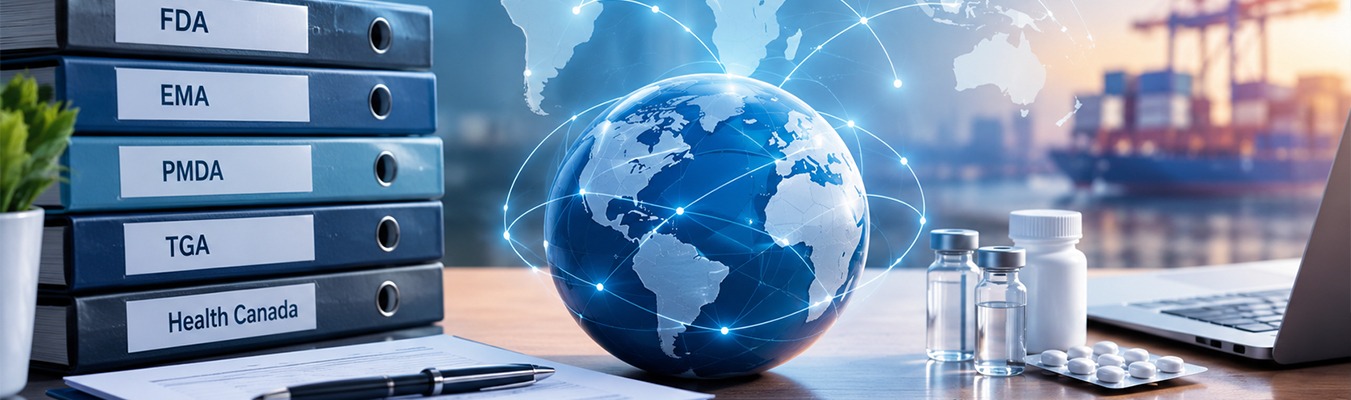
- US Food and Drug Administration (FDA): oversees drugs, biologics and medical devices in the United States.
- European Medicines Agency (EMA): coordinates the centralised approval procedure across the European Union, alongside national authorities in each member state.
- Medicines and Healthcare products Regulatory Agency (MHRA): regulates medicines and devices in the United Kingdom.
- Health Canada: reviews and approves health products for the Canadian market.
- Pharmaceuticals and Medical Devices Agency (PMDA): works with Japan’s Ministry of Health on product reviews.
- Therapeutic Goods Administration (TGA): regulates medicines and devices in Australia.
- Saudi Food and Drug Authority (SFDA) and other Gulf authorities: oversee products across the Middle East.
- Drug Regulatory Authority of Pakistan (DRAP): regulates pharmaceutical products in Pakistan.
While ICH guidelines have brought many of these agencies closer together, each still has unique requirements for Module 1, labelling, local language translations, fees and review timelines. A submission that works perfectly in one country may need significant adjustments for another.
The Regulatory Submission Process, Step by Step
Every project is different, but most submissions follow a similar path:
1. Gap Analysis and Regulatory Strategy
The process starts with a review of your existing data against the requirements of your target market. A gap analysis shows what is missing, what needs updating and which pathway offers the fastest route to approval. This is also the stage to plan pre-submission meetings with regulators, which can clarify expectations early.
2. Data Collection and Planning
The team gathers documents from research, manufacturing, quality and clinical departments, along with any contract partners. A detailed submission plan sets out responsibilities, deadlines and the dossier structure.
3. Authoring and Medical Writing
Specialist writers prepare the summaries, overviews and technical sections. Clear, accurate writing is essential: reviewers should be able to follow the scientific story without hunting for data across thousands of pages.
4. Review and Quality Control
Every document is checked for scientific accuracy, consistency across modules and compliance with guidelines. Even small inconsistencies, such as different values for the same specification in two sections, can trigger questions.
5. Publishing and Validation
Documents are formatted, hyperlinked and compiled into the required electronic format. The dossier is then run through validation tools to catch technical errors before it reaches the agency.
6. Submission and Agency Interaction
The dossier is sent through the agency’s electronic gateway or portal. During review, the team responds to questions and deficiency letters quickly and thoroughly to keep the timeline on track.
7. Approval and Lifecycle Management
After approval, the work continues with variations, renewals, labelling updates and safety reporting for as long as the product remains on the market.
Common Submission Challenges and How to Avoid Them
Even experienced teams run into problems. These are some of the most frequent, along with practical ways to prevent them:
| Challenge | How to avoid it |
|---|---|
| Incomplete or missing data | Run a thorough gap analysis early and agree on a document checklist with every contributor. |
| Inconsistencies between modules | Use a single source of truth for key data, and cross-check summaries against source reports. |
| Technical validation errors | Use validated publishing software and run pre-submission validation checks. |
| Changing regulatory guidelines | Monitor agency updates and review guidance before each submission. |
| Tight deadlines | Build a realistic timeline with buffer time for reviews and unexpected requests. |
| Country-specific requirements | Work with experts who know local Module 1 rules, labelling and language needs. |
| Slow responses to agency questions | Prepare a response team in advance and keep source data organised and easy to access. |
Most of these issues have one thing in common: they are far easier and cheaper to prevent than to fix once the dossier is under review.
The Benefits of Outsourcing Regulatory Submissions
Building a full in-house regulatory team takes time, money and specialist expertise that many companies, especially small and mid-sized ones, simply don’t have. Partnering with a regulatory submission service offers clear advantages:
- Specialist expertise on demand: access to regulatory strategists, medical writers and publishing specialists without hiring full-time staff.
- Faster time to market: experienced teams know what regulators expect, which reduces delays and rounds of questions.
- Lower costs: avoid investing in expensive publishing software, training and infrastructure.
- Global reach: get support for multiple markets, with knowledge of local requirements in each country.
- Flexibility: scale support up or down depending on your pipeline and submission schedule.
- Reduced risk: independent quality checks catch errors your internal team might miss.
- More focus on your core work: your scientists and managers can concentrate on research, development and commercial planning.
How to Choose the Right Regulatory Submission Partner
Not all regulatory service providers are the same. Before you sign an agreement, ask these questions:
- Do they have experience with your product type? Small molecules, biologics, generics, herbal products and medical devices each have very different requirements.
- Do they know your target markets? Look for proven experience with the specific agencies you plan to submit to.
- Can they handle the full process? A partner that covers strategy, writing, publishing and agency communication reduces handover gaps.
- What technology do they use? Ask about their publishing and validation tools, and how they manage version control.
- How do they ensure quality? A clear review process with independent checks is a strong sign of reliability.
- How do they protect your data? Confidentiality agreements and secure document handling are essential.
- How do they communicate? Regular updates, a named point of contact and transparent timelines make the process much smoother.
- Can they support you after approval? Lifecycle management is an ongoing need, so long-term support adds real value.
The right partner should feel like an extension of your own team, not just a vendor processing paperwork.
Trends Shaping the Future of Regulatory Submissions
The regulatory world is changing quickly. These trends are already reshaping how submissions are prepared and reviewed:
- Digital-first submissions: paper dossiers are largely a thing of the past, and electronic formats such as eCTD continue to expand to more countries and product types.
- eCTD 4.0: the next generation of the format is designed to make data exchange between companies and regulators more efficient, and agencies are gradually adopting it.
- Structured data and IDMP: regulators increasingly want product information in standardised, structured formats rather than static documents.
- Reliance and work-sharing pathways: more agencies now use decisions from trusted reference regulators to speed up their own reviews, creating faster routes for companies with existing approvals.
- AI and automation: artificial intelligence is starting to support tasks such as document drafting, consistency checks and literature reviews, while human experts remain essential for scientific judgement.
- Greater focus on real-world evidence: data from everyday clinical practice is playing a growing role in supporting submissions and post-approval decisions.
Companies that stay ahead of these changes will be better placed to submit faster and enter new markets with confidence.
Frequently Asked Questions
What is a regulatory submission?
A regulatory submission is a formal package of documents sent to a health authority to request permission to test, market or change a medicine, biologic or medical device.
How long does it take to prepare a regulatory submission?
It depends on the type of submission and how complete your data is. A simple variation may take a few weeks, while a full marketing application can take several months to prepare.
What is the difference between CTD and eCTD?
The CTD is the standard structure for organising a dossier into five modules. The eCTD is the electronic version of that structure, with hyperlinks and an XML backbone that agencies use to review and track submissions.
Can one dossier be used for multiple countries?
Largely, yes. Modules 2 to 5 of the CTD are harmonised across many markets, but Module 1 and certain local requirements must be adapted for each country.
What happens if a regulator finds problems with my submission?
The agency will usually send questions or a deficiency letter. Responding quickly, clearly and completely is key to keeping the review on schedule.
Do small companies need regulatory submission services?
Often, yes. Smaller companies rarely have a full in-house regulatory team, so outsourcing gives them access to the expertise they need without the cost of hiring and training specialists.
Do regulatory services continue after approval?
Yes. Lifecycle management, including variations, renewals, labelling updates and safety reports, is an ongoing requirement for every approved product.
Conclusion: Turn Your Submission Into a Smooth Path to Approval
A regulatory submission is far more than paperwork. It is the final, critical step that turns years of scientific work into a product patients can actually use. With strict formats, changing guidelines and country-specific rules, even small mistakes can lead to costly delays. The companies that succeed are the ones that plan early, write clearly, check thoroughly and work with experts who understand what regulators expect.
That is exactly where Pharma Wizard Consultancy can help. Our team supports pharmaceutical, biotech and healthcare companies at every stage of the regulatory journey, from early strategy and gap analysis to dossier preparation, eCTD publishing, agency communication and post-approval lifecycle management. We take the complexity off your shoulders, so you can focus on what you do best: developing products that improve lives.
Ready to make your next submission your smoothest yet? Get in touch with Pharma Wizard Consultancy today to discuss your project and find out how we can help you reach your target markets faster and with confidence.