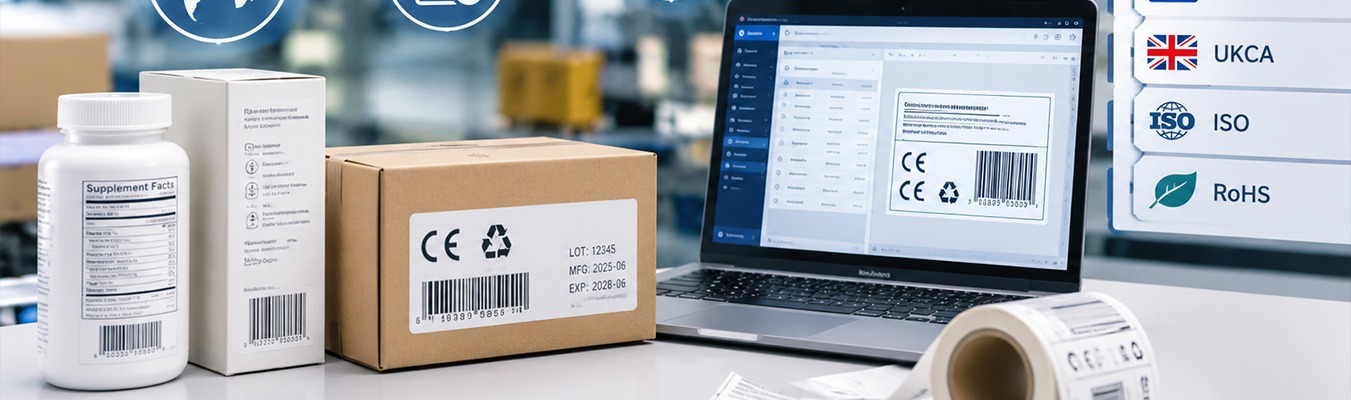
Quick answer: Regulatory labeling automation services use specialised software, structured content and expert workflows to create, update, review and submit product labels for medicines, medical devices and other regulated products. They replace manual, document-heavy processes with automated, traceable systems that cut errors, speed up label changes and keep companies compliant with health authorities around the world.
Every medicine on a pharmacy shelf carries far more than a brand name. Its carton, container label, patient leaflet and prescribing information contain carefully controlled text, approved by regulators and backed by scientific evidence. A single wrong dosage, missing warning or outdated safety statement can put patients at risk, trigger product recalls and lead to serious regulatory action.
For life sciences companies selling in dozens of countries, managing this content is a huge challenge. Labels must be translated into many languages, adapted to local regulations and updated quickly whenever new safety information emerges. Traditional manual processes, built on spreadsheets, emails and word-processing files, simply cannot keep pace.
This is why regulatory labeling automation has become a priority for pharmaceutical, biotechnology and medical device organisations worldwide. This guide explains what it is, how it works, the benefits it brings and how to choose the right approach for your organisation.
What Is Regulatory Labeling?
Regulatory labeling is the process of creating, approving and maintaining all the official product information that accompanies a regulated product, in line with the requirements of health authorities. For pharmaceuticals, this typically includes:
- Core labeling documents, such as the Company Core Data Sheet (CCDS), which holds the company’s global position on safety and efficacy.
- Prescribing information for healthcare professionals, such as the US Prescribing Information (USPI) or the EU Summary of Product Characteristics (SmPC).
- Patient information, such as patient information leaflets (PILs) and medication guides.
- Packaging components, including cartons, container labels, blister foils and inserts.
- Electronic formats, such as Structured Product Labeling (SPL) and electronic product information (ePI).
Why Is Regulatory Labeling So Complex?
Regulatory labeling is complex because the same product information must stay accurate and consistent across many documents, languages, markets and packaging formats at once. Several factors add to the challenge:
- Multiple markets: A single product may be sold in 50 or more countries, each with its own rules, templates and approval timelines.
- Frequent changes: New safety data, regulatory requests and manufacturing updates can trigger label changes at any time.
- Strict deadlines: Safety-related updates often have tight implementation timelines set by health authorities.
- Translation demands: Labels must be accurately translated and culturally adapted for each market.
- Traceability requirements: Companies must show exactly what changed, why, when and who approved it.
When these processes are handled manually, the risk of inconsistency, delay and human error rises sharply.
What Are Regulatory Labeling Automation Services?
Regulatory labeling automation services combine technology, process design and regulatory expertise to manage product labeling digitally from start to finish. Instead of copying text between documents by hand, companies store approved content once and reuse it automatically across every label, language and market.
These services usually cover three areas:
- Technology: Implementing and configuring labeling platforms, structured content systems, artwork management tools and integrations with regulatory information management (RIM) systems.
- Process: Redesigning workflows so that label changes move smoothly through authoring, review, approval, submission and implementation.
- Expertise: Providing regulatory labeling specialists who understand global requirements and can manage, validate and continuously improve the automated system.
How Is Automated Labeling Different from Traditional Labeling?
Traditional labeling relies on manually editing individual documents. Automated labeling treats content as structured, reusable data.
| Aspect | Traditional labeling | Automated labeling |
|---|---|---|
| Content storage | Separate Word and PDF files | Central, structured content library |
| Updating text | Manual edits in every document | Update once, reuse everywhere |
| Change tracking | Emails and spreadsheets | Automatic audit trails |
| Translations | Full re-translation of documents | Only changed content is translated |
| Proofreading | Manual side-by-side checks | Automated text comparison |
| Visibility | Limited, scattered status updates | Real-time dashboards |
What Are the Key Components of Regulatory Labeling Automation?
A complete regulatory labeling automation solution typically brings together the following capabilities:
Structured Content Authoring
Label text is broken into reusable components, such as indications, dosage, contraindications and warnings. Each component is approved once and then reused across all relevant documents, which keeps wording consistent everywhere.
Change Management and Workflow Automation
When a safety update or regulatory request arrives, the system automatically identifies every affected label, assigns tasks to the right people and tracks progress against deadlines.
Global and Local Label Alignment
Automation links core company documents to local labels in each market, making it easy to see where local text differs from the global position and whether those differences are justified.
Translation Management
Integrated translation tools use translation memory to reuse previously approved translations. Only new or changed text needs to be translated, saving time and reducing costs.
Artwork Management
Approved text flows directly into packaging artwork, reducing manual retyping. Automated proofreading tools compare artwork against the approved source text to catch errors before printing.
Electronic Submission Formats
The system can generate regulator-ready formats such as Structured Product Labeling (SPL) for the US Food and Drug Administration and support emerging electronic product information (ePI) standards.
Audit Trails and Compliance Reporting
Every change, review and approval is recorded automatically, helping companies demonstrate compliance during inspections and audits.
What Are the Benefits of Regulatory Labeling Automation?
The main benefits of regulatory labeling automation are fewer errors, faster label updates, stronger compliance and lower operating costs. In more detail:
- Improved patient safety: Consistent, accurate labels mean patients and healthcare professionals always receive the latest safety information.
- Fewer errors and recalls: Reusing approved content and automating proofreading greatly reduces the chance of typos, missing warnings and mismatched text. Labeling errors are a well-known cause of product recalls, so prevention protects both patients and revenue.
- Faster implementation of label changes: Automated impact analysis and workflows help companies roll out updates across all markets within regulatory deadlines.
- Stronger compliance and inspection readiness: Complete audit trails make it easy to show regulators how each label was created and approved.
- Lower costs: Less manual effort, reduced translation volumes and fewer printing errors lead to significant savings over time.
- Better global visibility: Real-time dashboards show the status of every label in every market, helping leaders spot risks early.
- Scalability: Automated systems make it easier to launch new products, enter new markets and handle growing portfolios without adding large teams.
- Happier, more productive teams: Specialists spend less time on repetitive copying and checking, and more time on high-value regulatory work.
How Does Regulatory Labeling Automation Work?
Regulatory labeling automation works by managing every stage of the label lifecycle in one connected, digital process. A typical automated lifecycle looks like this:
- Trigger: A change is identified, such as new safety data, a health authority request or a manufacturing update.
- Impact assessment: The system automatically finds every product, market, document and pack affected by the change.
- Core content update: Labeling experts update the approved global content, such as the CCDS.
- Local adaptation: Changes flow to local labels, where regional teams adapt them to national requirements.
- Translation: Only new or changed content is sent for translation, using approved translation memory.
- Review and approval: Automated workflows route documents to medical, regulatory, legal and quality reviewers, with electronic signatures.
- Regulatory submission: Labels are prepared in the required formats and submitted to each health authority.
- Artwork and packaging: Approved text flows into packaging artwork, with automated proofreading before printing.
- Implementation and tracking: The system tracks when each market implements the new label and confirms compliance with deadlines.
- Archiving and reporting: All records are stored securely for audits, inspections and future reference.
Because each step is connected, information moves smoothly between teams, and nothing falls through the cracks.
What Global Regulations Affect Product Labeling?
Labeling requirements differ from one region to another, which is one of the main reasons automation is so valuable for companies operating internationally. Some key examples include:
- United States: The FDA requires prescribing information in a defined format and uses Structured Product Labeling (SPL), an XML-based standard, for electronic submission of labeling content.
- European Union: The European Medicines Agency (EMA) uses Quality Review of Documents (QRD) templates for the SmPC, labeling and package leaflet, and the EU is advancing electronic product information (ePI) for medicines.
- United Kingdom: The Medicines and Healthcare products Regulatory Agency (MHRA) sets its own labeling and leaflet requirements following the UK’s exit from the EU.
- Asia-Pacific: Authorities such as Japan’s PMDA, China’s NMPA and Australia’s TGA each apply their own formats, language rules and review processes.
- Middle East, Africa and Latin America: Many markets require labels in local languages, often with country-specific information and registration details.
- Global standards: International initiatives such as ISO Identification of Medicinal Products (IDMP) standards are pushing the industry towards more structured, data-driven product information.
Automation helps companies manage this complexity by storing regional rules and templates in one system and applying them consistently.
How Is AI Changing Regulatory Labeling?
Artificial intelligence is making regulatory labeling faster and smarter by helping teams analyse, compare and draft content, while human experts remain responsible for final decisions. Key applications include:
- Intelligent text comparison: AI tools quickly identify differences between global and local labels, highlighting gaps that need attention.
- Automated impact analysis: Machine learning can scan large label portfolios to find every document affected by a new safety finding.
- Assisted authoring: AI can suggest draft wording based on previously approved content, speeding up the authoring process.
- Translation support: Neural machine translation, combined with expert human review, can reduce translation turnaround times.
- Regulatory intelligence: AI can monitor regulatory updates across countries and alert teams to new labeling requirements.
What Trends Will Shape the Future of Regulatory Labeling?
- Electronic product information (ePI): Digital, regularly updated leaflets that patients can access through QR codes or apps.
- Structured data standards: Wider adoption of IDMP and data-centric approaches that treat labels as connected data rather than documents.
- Cloud-based platforms: Flexible, scalable systems that connect global teams and partners in real time.
- End-to-end integration: Closer links between labeling, regulatory information management, artwork, supply chain and pharmacovigilance systems.
- Sustainability: Digital leaflets and smarter packaging that reduce paper use and waste.
As regulators continue to embrace digital tools, organisations that automate early will be better placed to adapt.
How Do You Choose a Regulatory Labeling Automation Provider?
The best regulatory labeling automation provider combines deep regulatory knowledge with proven technology experience and a clear, phased implementation approach. When comparing providers, ask:
- Do they understand global labeling regulations? Look for specialists with hands-on experience across the FDA, EMA, MHRA and other authorities.
- Are they technology-neutral? A good provider recommends the right platform for your needs rather than pushing a single product.
- Can they redesign processes, not just install software? Automation delivers the best results when workflows are improved at the same time.
- Do they offer validation support? Systems used for regulated activities usually need computer system validation and must support data integrity and electronic records requirements.
- Can they migrate legacy content? Converting existing labels into structured content is often the most demanding part of a project.
- Do they provide ongoing support? Managed services, training and continuous improvement help you get lasting value.
What Are the Common Challenges of Implementation?
- Legacy content: Years of unstructured documents must be cleaned, standardised and migrated.
- Change resistance: Teams used to manual methods may need training and support to adopt new ways of working.
- System integration: Connecting labeling tools with RIM, artwork and document management systems requires careful planning.
- Data quality: Automation is only as reliable as the content it uses.
A phased approach helps overcome these challenges. Many companies start with a pilot product or region, prove the value, and then scale across their portfolio.
Frequently Asked Questions
What is regulatory labeling automation?
Regulatory labeling automation is the use of software and structured workflows to create, update, review, approve and submit product labeling for regulated products such as medicines and medical devices, with minimal manual effort.
Who needs regulatory labeling automation services?
Pharmaceutical, biotechnology, generic, consumer health and medical device companies benefit most, especially those selling products in multiple countries or managing large product portfolios.
What is Structured Product Labeling (SPL)?
Structured Product Labeling is an XML-based document standard used by the US FDA to receive product labeling electronically. It allows labeling content to be read and processed by computer systems.
What is a Company Core Data Sheet (CCDS)?
A CCDS is a company’s internal reference document that sets out its global position on a product’s safety and efficacy information. Local labels in each country are aligned with it.
What is electronic product information (ePI)?
Electronic product information is a digital, structured version of a medicine’s official product information, designed to be easily updated and accessed online by patients and healthcare professionals.
How long does it take to implement labeling automation?
Timelines vary with portfolio size, number of markets and the condition of existing content. A pilot can often be delivered within a few months, while a full global rollout may take a year or more.
Does automation replace regulatory labeling specialists?
No. Automation removes repetitive manual tasks, but expert judgement remains essential for interpreting regulations, approving content and making decisions about patient safety.
Is regulatory labeling automation only for large companies?
No. Cloud-based platforms and managed services make automation accessible to small and mid-sized companies, which often benefit from reduced workloads and faster market access.
Conclusion: Building a Smarter, Safer Labeling Future
Regulatory labeling sits at the heart of patient safety and product compliance. As portfolios grow, markets expand and regulators move towards digital, structured information, manual labeling processes become harder, slower and riskier to maintain. Regulatory labeling automation offers a clear way forward, delivering consistent content, faster label changes, complete traceability and lower costs.
Pharma Wizard Consultancy helps life sciences companies around the world plan, implement and manage regulatory labeling automation. By combining regulatory labeling expertise with practical technology and process know-how, Pharma Wizard Consultancy supports organisations at every stage, from assessing current processes and selecting the right platform to migrating content, validating systems and providing ongoing labeling support.
If you are ready to reduce labeling risk, accelerate compliance and free your teams to focus on what matters most, contact Pharma Wizard Consultancy today to discuss how automation can transform your regulatory labeling operations.