If you are a healthcare provider, you know the struggle. You walk into an exam room, have a meaningful, empathetic conversation with a patient, and then spend the next hour staring at a screen, clicking endless boxes to satisfy the requirements of your Electronic Medical Record (EMR). It is one of the biggest contributors to physician burnout today.
But what if you could simply talk to your EMR and have it accurately document the visit for you?
Voice-to-Text EMR technology has moved from a futuristic idea to a real clinical necessity. The key question remains: Is Voice-to-Text EMR reliable enough for sensitive patient data and clinical documentation?
This analysis breaks down accuracy, reliability, efficiency, and real-world usability from a customer perspective so healthcare professionals can make an informed decision.
What is Voice-to-Text EMR?
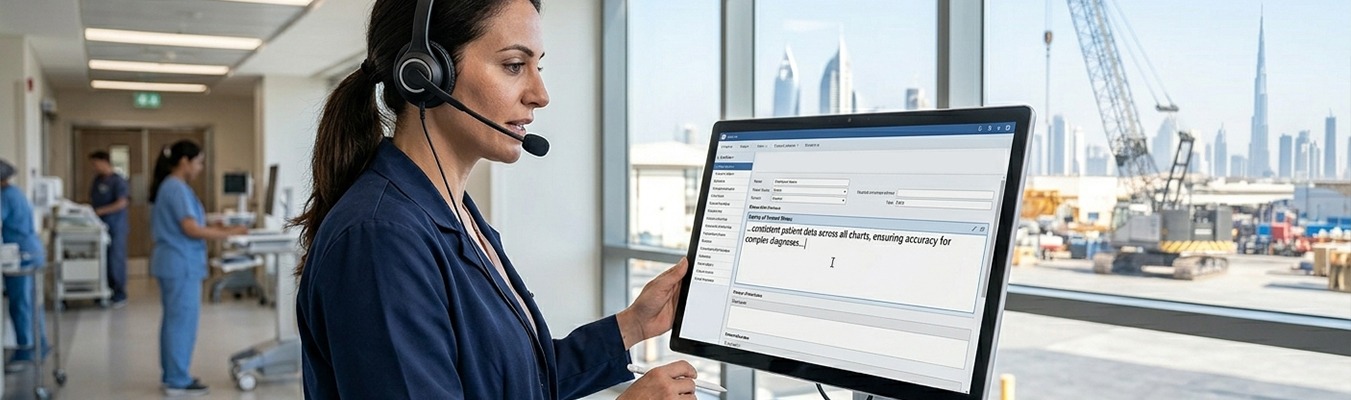
Voice-to-Text EMR (also known as Medical Dictation Software or AI Medical Scribing) uses speech recognition technology to convert spoken language into structured clinical documentation in real time.
Modern systems go beyond basic transcription. Advanced AI Medical Scribes use Natural Language Processing (NLP) to understand clinical meaning, separate symptoms from diagnoses, and automatically structure notes inside an EHR system.
Instead of just converting words, these systems interpret medical intent and transform doctor–patient conversations into usable clinical records. This is why searches like “AI EMR documentation” and “medical transcription software” are increasing rapidly.
The Reliability Factor: Accuracy vs Clinical Understanding
When healthcare professionals ask, “Is it reliable?” they usually mean two things:
- Does it hear correctly?
- Does it understand clinical context?
1. Speech Recognition Accuracy
Earlier dictation tools had frequent errors, especially with medical terminology. However, cloud-based AI has significantly improved performance.
Today’s Speech Recognition in Healthcare systems achieve over 95% accuracy, often surpassing manual typing in speed and consistency.
These systems are trained on large clinical datasets, allowing them to:
- Recognize different accents
- Filter background noise
- Adapt to individual speaking styles
This makes modern Medical Dictation Software far more reliable than older systems.
2. Clinical Context (NLP Understanding)
True reliability depends on understanding meaning, not just words.
For example, when a doctor says, “The patient presents with acute bronchitis,” the system correctly identifies:
- “Acute” as a modifier
- “Bronchitis” as the diagnosis
It also distinguishes between:
- “Negative findings” in clinical exams
- “Negative response” in patient feedback
This level of clinical context awareness is essential for Clinical Documentation Integrity (CDI) and reduces documentation errors significantly.
Customer Perspective: Why Reliability Matters
From a clinician’s point of view, reliability directly impacts workflow and patient care.
1. Better Patient Interaction
One of the biggest issues in modern healthcare is reduced patient engagement due to EMR typing.
With reliable Voice-to-Text EMR, doctors can maintain eye contact, listen actively, and document naturally without interrupting conversations. This improves doctor–patient communication and overall patient satisfaction.
2. Reduced Documentation Burnout
Documentation overload is a major cause of physician burnout.
If a system requires constant correction, it becomes a burden. However, efficient AI Medical Transcription systems can reduce documentation time by 50–70%, allowing physicians to finish notes during or immediately after consultations.
Eliminates the hassle of staying late after work to finish your charts.
3. Billing and Coding Accuracy
Reliable documentation is also critical for financial performance.
Accurate EMR transcription systems help ensure:
- Correct ICD-10 coding
- Proper documentation of severity and chronicity
- Fewer insurance claim rejections
This improves revenue cycle efficiency and compliance accuracy.
Challenges of Voice-to-Text EMR
Despite advancements, limitations still exist:
Accent and Speech Variability: Strong accents or fast speech may still reduce accuracy. Most systems require a short learning phase to adapt.
Complex Medical Terminology: Specialized fields like oncology or rare diseases may require custom vocabulary setup.
Clinical Environment Noise: Busy hospital environments can impact transcription quality, although noise reduction has improved significantly.
Speech Habits: Filler words like “um” or “you know” are usually filtered, but only when systems are properly configured for clinical use.
Voice-to-Text EMR vs Human Scribes
Traditionally, hospitals used human scribes, but AI systems are rapidly replacing them.
Cost: Human scribes are expensive, requiring salaries and training. AI is significantly more cost-effective.
Availability: Humans have limited shifts; AI works 24/7 without interruption.
Privacy: Human scribes are exposed to sensitive data. In contrast, HIPAA-compliant EMR systems encrypt data and reduce exposure risks.
Overall, AI provides consistent performance, while human output may vary.
How to Choose a Reliable System
Healthcare providers should evaluate:
EHR Integration: Must work smoothly with systems like Epic, Cerner, or AthenaHealth.
Custom Vocabulary: Ability to add specialty-specific terms improves accuracy.
Mobile Access: Should work across devices, including phones and tablets.
Security Compliance: Ensure HIPAA compliance, encryption, and Business Associate Agreements (BAA).
Final Verdict: Is It Reliable?
Yes! Voice-to-Text EMR is highly reliable for clinical documentation when properly implemented.
It does not replace clinical judgment but enhances efficiency, accuracy, and workflow.
For most specialties including primary care, cardiology, orthopedics, and internal medicine, it provides a strong alternative to manual documentation.
While a learning curve exists, benefits are clear:
- Reduced physician burnout
- Faster documentation
- Improved patient interaction
- Better clinical accuracy
In modern healthcare, Voice-to-Text EMR is becoming an essential tool, not an optional one.
FAQs
Is Voice-to-Text EMR HIPAA compliant?
Yes. Most systems use encryption and compliance agreements for data security.
How much time can it save?
Typically 1–2 hours per day per physician.
Do I need special equipment?
No. Most systems work with built-in microphones, though headsets improve accuracy.
Can it handle specialties?
Yes. Custom vocabularies support fields like radiology, surgery, and pathology.