Human transcription advantagesElectronic Medical Records (EMR) have transformed modern healthcare documentation. However, one major question continues to arise in hospitals and clinics: Should providers rely on voice recognition in EMR transcription or stick with human transcription?
As healthcare organizations focus on accuracy, compliance, and workflow efficiency, choosing between AI-powered speech recognition and professional medical transcription services has become a strategic decision.
In this article, we’ll explore AI vs human transcription accuracy, cost differences, compliance concerns, and the future of EMR transcription technology.
Understanding Voice Recognition in EMR Transcription
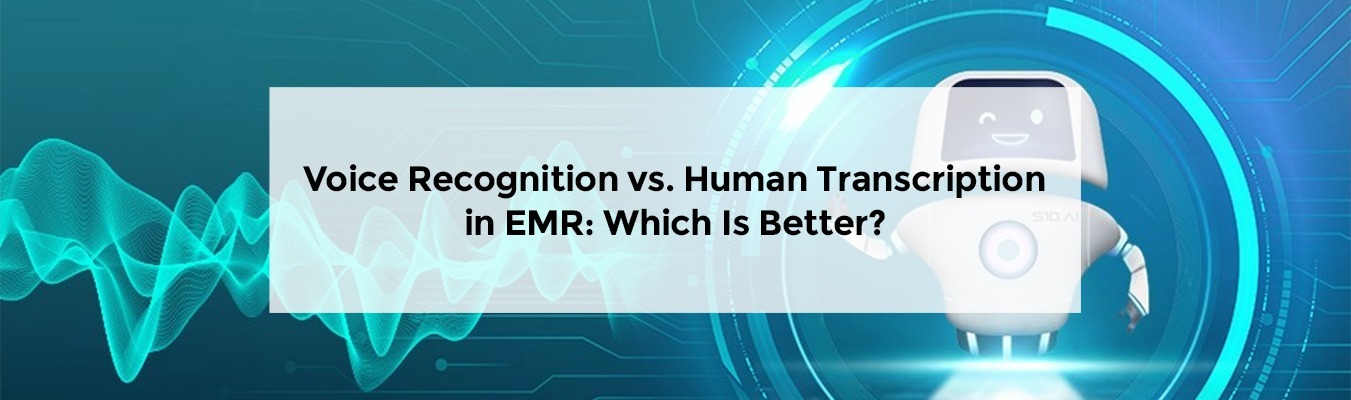
Voice recognition in EMR transcription uses artificial intelligence (AI) and speech recognition software to convert spoken words into text in real time. Providers dictate directly into the system, and the software transcribes the content into the Electronic Health Record (EHR).
Key Benefits of Speech Recognition for Medical Records
- Faster documentation turnaround
- Real-time chart completion
- Reduced dependency on manual transcription
- Immediate EHR integration with voice recognition systems
- Potential cost savings in the short term
Speech recognition for medical records has improved significantly with machine learning. Some platforms claim high accuracy rates, particularly when trained to recognize a physician’s voice patterns.
However, the technology is not flawless.
Human Transcription Advantages in Healthcare
Despite AI advancements, human transcription advantages in healthcare remain significant. Professional medical transcriptionists are trained to understand complex terminology, accents, context, and clinical nuances.
Why Human Transcription Still Matters
- Better contextual understanding
- Accurate interpretation of medical jargon
- Error correction and quality review
- Adaptability to multiple specialties
- Compliance with HIPAA compliant transcription solutions
Human transcription services often include multi-level quality checks, which improve overall documentation reliability.
AI vs Human Transcription Accuracy
Accuracy is critical in healthcare documentation. Even minor errors in EMR notes can lead to incorrect treatments, billing issues, or compliance violations.
AI Accuracy Challenges
- Difficulty with heavy accents
- Background noise interference
- Confusion between similar medical terms
- Misinterpretation of abbreviations
Although AI continues to improve, AI vs human transcription accuracy comparisons often show that human-reviewed documents maintain higher precision, particularly in complex cases.
Human transcriptionists can recognize when something doesn’t make clinical sense and correct it accordingly — something automated systems struggle to do independently.
Cost Comparison: Voice Recognition vs Transcription
One of the main reasons healthcare providers consider switching to AI is cost.
Voice Recognition Costs
- Software licensing fees
- Ongoing subscription costs
- Training time for physicians
- Editing time by staff
Human Transcription Costs
- Per-line or per-minute service fees
- Outsourcing medical transcription services contracts
- Quality assurance processes
While AI may seem cheaper initially, hidden costs such as physician editing time and documentation errors can reduce productivity. In some cases, physicians spend additional time correcting AI-generated notes, impacting healthcare workflow efficiency transcription goals.
HIPAA Compliance and Data Security
Healthcare documentation must meet strict privacy standards. HIPAA compliant transcription solutions ensure:
- Secure data handling
- Encrypted file transfers
- Access control measures
- Confidentiality agreements
When outsourcing medical transcription services, reputable vendors prioritize compliance and security. Voice recognition platforms must also meet these standards, but cloud-based systems require careful vendor evaluation.
Healthcare Workflow Efficiency Transcription
Efficiency is more than speed — it includes accuracy, physician satisfaction, and reduced administrative burden.
Voice Recognition Workflow
- Immediate note creation
- Requires physician review and correction
- Can slow providers if error rate is high
Human Transcription Workflow
- Dictation recorded
- Transcription completed by professionals
- Notes returned ready for review
Many healthcare facilities adopt a hybrid model — combining speech recognition for medical records with human editing for maximum efficiency and quality.
EHR Integration with Voice Recognition
Modern systems offer seamless EHR integration with voice recognition tools. This allows providers to:
- Dictate directly into patient charts
- Use templates and structured data fields
- Access voice commands for navigation
However, integration quality varies depending on the EMR system and vendor support. Proper setup and customization are essential to maximize benefits.
Outsourcing Medical Transcription Services
Outsourcing medical transcription services remains a strong option for hospitals seeking:
- Scalability
- Consistent quality
- Reduced administrative workload
- Predictable costs
Professional transcription companies often provide 24/7 support, multiple specialty expertise, and guaranteed turnaround times.
The Future of EMR Transcription Technology
The future of EMR transcription technology is likely to involve AI-human collaboration rather than competition.
Emerging trends include:
- AI-assisted transcription with human editing
- Natural language processing (NLP) integration
- Automated coding suggestions
- Improved contextual AI learning
Rather than replacing human transcription, AI is increasingly becoming a tool that enhances efficiency while humans maintain quality control.
Final Verdict: Which Is Better?
There is no one-size-fits-all answer.
Voice recognition in EMR transcription offers speed and convenience. Human transcription advantages in healthcare provide superior accuracy and contextual understanding.
For small practices focused on speed, speech recognition for medical records may be sufficient. For hospitals handling complex cases, combining AI with HIPAA compliant transcription solutions often delivers the best results.
In today’s healthcare environment, the smartest approach may not be choosing one over the other — but strategically integrating both to optimize healthcare workflow efficiency transcription while maintaining high documentation standards.